


Name: Wuyishan
Address: Wuyishan Shi, Nanping Shi, Fujian Sheng
Official / related site URL: http://whc.unesco.org/en/list/911/
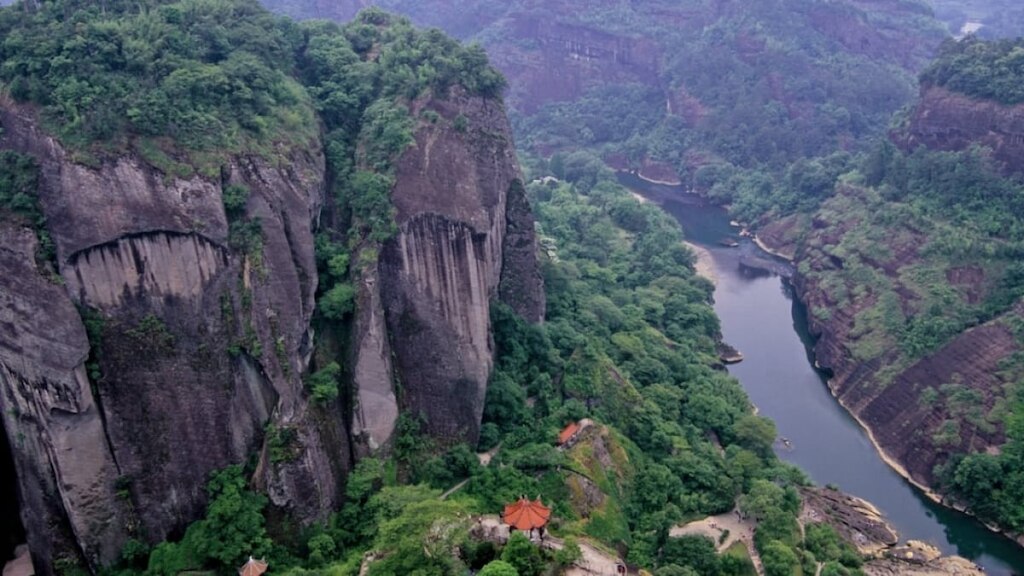
【World Heritage Site】What is Wuyishan?|A region adorned with strange rocks and streams
Apr 22, 2026
323 views
Would you like to fully enjoy the beautiful scenery that feels like stepping into an ink painting? Wuyishan in Fujian Province, China, registered as a UNESCO World Heritage Site, is exactly such a place. It is a land of stunning nature and numerous historic buildings.
Why not take a break from the hustle and bustle of daily life and explore Wuyishan, where vast and beautiful landscapes await? Here, we will introduce the charm of Wuyishan.
table of contents
[x] close
【World Heritage Site】What is Wuyishan?|A region adorned with strange rocks and streams
What is Wuyishan?
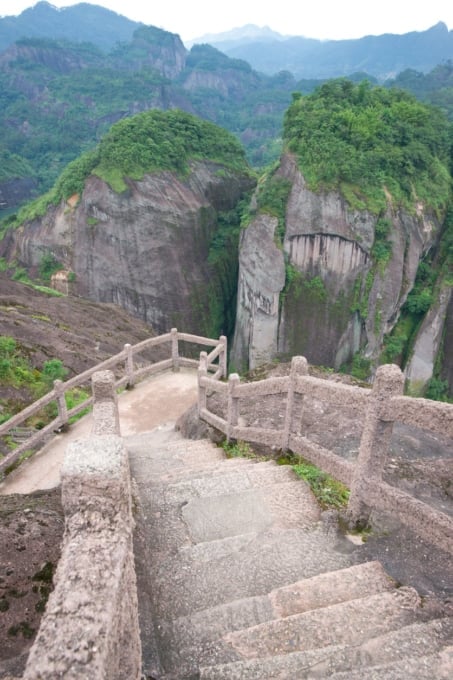
Wuyishan, a UNESCO World Heritage Site, is located in Wuyishan City, Nanping, Fujian Province, China. The landscapes woven by Wuyishan’s rich nature resemble the world of ink wash paintings. Its bizarre rocks and streams are praised as "the most magnificent scenery in Southeast China," described as "Qixiu Jiadongnan."
In addition, wild tea trees grow naturally in Wuyishan, and the oolong tea made from the leaves harvested here is renowned for its excellent fragrance and flavor. Among them, tea leaves that grow clinging to the rocky cliffs are called "Wuyi Rock Tea," considered the highest grade.
Access to Wuyishan
When traveling from Japan to Wuyishan by plane, there are no direct flights to Wuyishan Airport during the day. The common route is via Shanghai. It takes about 3 hours from Tokyo Narita Airport to Shanghai, and then about 1 hour 20 minutes from Shanghai to Wuyishan Airport. By train within China, it takes about 3 hours from Shanghai or about 1 hour from Fuzhou.
From the airport, you can reach the city center of Wuyishan by hotel shuttle services or by taking a local bus.
Highlights of World Heritage Wuyishan ① Jiuqu Stream Rafting
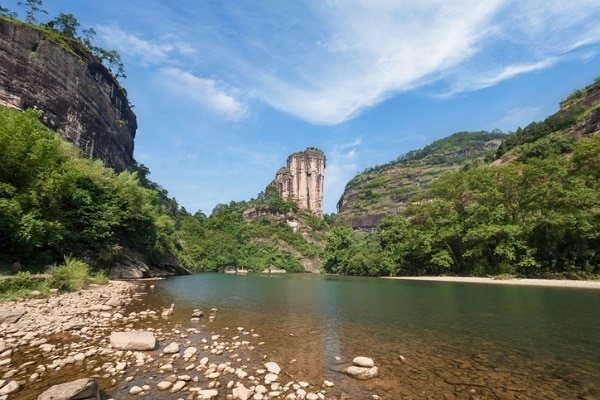
You can ride a bamboo raft along the scenic Jiuqu Stream. From Xingcun, the starting point, to Wuyi Palace, the endpoint, it is 9.5 km. The journey takes about an hour and a half, allowing you to leisurely enjoy the river scenery.
Along the banks of Jiuqu Stream stand 36 rocky peaks, with the most famous being "Yunu Peak" (Maiden Peak), named because its beautiful rock surface is compared to a beautiful woman. On the opposite bank stands "Dawang Peak" (King Peak), said to be her lover. Between the two is a dark rock called "Tieban Gui" (Iron Plate Demon), which legend says blocks the two from meeting—a fascinating tale.
Although rafting may get your feet wet, drifting down the river on a bamboo raft while viewing landscapes resembling traditional landscape paintings is a rare and precious experience. Definitely worth trying.
② Wuyi Palace
Wuyishan is famous not only for nature but also for cultural attractions. Among them, the "Wuyi Palace Scenic Area" offers both historical buildings like "Wuyi Palace" and natural beauty like Dawang Peak. At the center is Wuyi Palace, located at the end of the Jiuqu rafting course. After disembarking, you pass through "Fang Song Ancient Street," a street reproducing Qing dynasty townscapes, to reach it.
Wuyi Palace is the oldest Taoist temple in Wuyishan, enshrining the mountain deity Wuyi Jun. Although repeatedly destroyed and rebuilt, the current structure reproduces one from the Qing dynasty. Within the Wuyi Palace Scenic Area, there are souvenir shops, making it a good stop during your visit.
③ Yixiantian (One Line Sky)
"Yixiantian" refers to a place where, passing through a narrow path formed by a giant rock fissure, the sky appears as just a single line. Wuyishan also has such a spot, and it is a popular tourist attraction.
Here, the upper part of a 60-meter-high rocky mountain is split vertically, creating a giant fissure about 1 meter wide. From inside, you can see light streaming straight through the crack. Visitors can climb stairs through this narrow passage and emerge outside, making for a thrilling experience.
Notes
Currently, sightseeing is permitted in only six scenic areas of Wuyishan: Tianyou Peak, Wuyi Palace, Yixiantian, Huxiao Rock, Shuiliandong (Water Curtain Cave), and Dahongpao (Big Red Robe) Scenic Area.
To cover all these areas requires at least 2 days, so it is recommended to plan a relaxed itinerary according to your stay duration.
◎Summary
We have introduced the highlights of Wuyishan, a World Heritage Site in Fujian Province, China. Registered as a mixed World Heritage Site, Wuyishan offers both natural and cultural experiences. Try rafting on Jiuqu Stream and take in the breathtaking scenery in full.
Wuyishan is also famous as a tea-producing region. Tea is a classic souvenir, so don’t forget to buy some. When you drink it at home, you might feel the refreshing breeze of Wuyishan once again.
RELATED ARTICLES


REGIONS
CATEGORIES
FEATURED ON Uncategorized
-
Once a phantom “land of frankincense” that boasted great prosperity! Oman’s World Heritage: The Land of Frankincense
-
Recommended Tourist Spots in Tete, a Commercial City in Northern Mozambique
-

Three Singapore-Style Recommended Cafés Found in the Marina Bay Area!
-

Let’s Spend a Relaxing Time in Hunan Province, Changde: 5 Recommended Tourist Spots!
-

Can’t Stop the Cuteness! 4 Recommended Souvenirs from the Handicraft Heaven of Guatemala
MOST POPULAR ON Uncategorized
-
 1
1How to Get to Taipei’s Raohe Street Night Market and Top Gourmet Spots
-
 2
2Must-Visit Stylish Tourist Spots in Horie, Osaka!
-
 3
350 Must-Visit Tourist Spots in Aomori Prefecture|Area-Specific Travel Guide
-
 4
420 recommended sightseeing spots in Tateshina, Nagano Prefecture! Enjoy all seasons
-
 5
5Top 8 Shopping Spots in Finland for Nordic Design Enthusiasts