


Name: Bikini Atoll
Address: Bikini Atoll
Official / related site URL: http://whc.unesco.org/en/list/1339/
The Marshall Islands World Heritage Site “Bikini Atoll Nuclear Test Site,” which conveys the threat of nuclear weapons
Apr 8, 2026
372 views
table of contents
[x] close
The Marshall Islands World Heritage Site “Bikini Atoll Nuclear Test Site,” which conveys the threat of nuclear weapons
The Bikini Atoll Nuclear Test Site, which in 2010 became the first World Heritage Site in the Marshall Islands, is located on Bikini Atoll, one of the Pacific Proving Grounds where the United States conducted 23 nuclear tests between 1946 and 1958. In 1946 the United States chose Bikini Atoll as a nuclear test site and forcibly relocated as many as 170 residents to an uninhabited island, but because of the meager fishing resources there, the residents soon faced starvation.
The first nuclear tests, conducted twice in July 1946, were called Operation Crossroads, atomic bomb tests targeting 71 warships of various sizes. These were the fourth and fifth nuclear explosions in history, following those in New Mexico, Hiroshima, and Nagasaki. Among the main target ships was Nagato, a battleship of the Imperial Japanese Navy that had been seized after World War II, as well as American warships such as USS Nevada, USS Arkansas, and USS New York.
During Operation Castle in 1954, in which the United States conducted six nuclear tests, a hydrogen bomb known as the Bravo test was detonated on March 1. It had an explosive power equivalent to 1,000 Hiroshima-type atomic bombs and created a crater about 120 meters deep and about 1.8 kilometers in diameter. Furthermore, more than 1,000 fishing boats were exposed to radioactive coral dust known as “death ash” and became contaminated; among these was the Japanese tuna fishing boat Daigo Fukuryū Maru (Lucky Dragon No. 5). Not only the fishing boats but also 64 inhabitants of Rongelap Atoll, located about 240 kilometers from Bikini Atoll, were exposed to radiation.
The current radiation level on Bikini Atoll makes it impossible to live there, but it is at a level that poses little problem for short-term stays such as tourism.
Access to the Bikini Atoll Nuclear Test Site
You can access it by airplane or boat from Majuro, the capital of the Marshall Islands. The journey takes about one day by boat.
Two recommended highlights of the Bikini Atoll Nuclear Test Site
The Japanese battleship Nagato lying on the seafloor
Today, Bikini Atoll has become a popular diving destination that attracts many divers. One of the reasons is that several warships, including the Japanese vessel Nagato, have remained sunk deep on the seafloor for about 70 years. Before World War II, the Imperial Japanese Navy’s battleship Nagato was regarded as a symbol of the Japanese Navy. When it was completed in 1920, it was a fast battleship equipped with 41 cm main guns, the largest caliber at the time, and capable of 26.5 knots, which was very fast among battleships of that era. It had a major impact on military history around the world.
Nagato, 216 meters in length and built at a cost of 43.9 million yen—enough to construct seven of Tokyo’s former Marunouchi Buildings—was counted among the “Big Seven” of the world’s battleships: two of Britain’s Nelson-class battleships, three of America’s Colorado-class battleships, and Japan’s Nagato and her sister ship Mutsu. Although it now lies on the seafloor, Nagato is the only one of the Big Seven that still exists, and many divers from around the world come to see it at least once. Due to the lingering effects of radiation from the nuclear tests, divers are not allowed to touch the hull directly, but even just viewing this rare battleship allows you to feel the many layers of history of Bikini Atoll.
Diving spot
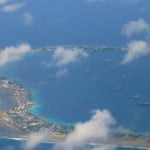
On Bikini Atoll there are hotels and bars right in front of the beautiful sea, and many palm trees line the island. The sunset views from the beach are stunning, making it a quiet, little-known resort where you can relax at leisure.
In the beautiful blue sea around Bikini Atoll, where you can see many coral reefs, enjoy diving to your heart’s content.
◎ Summary
Even now, the residents of Bikini Atoll are unable to return to their island, and it is estimated that humans will not be able to live there until around 2052 at the earliest. In addition, 28 species of coral became extinct as a result of the nuclear tests, but coral reefs have recovered across 80% of the area of Bikini Atoll. To ensure that such tragic history is never repeated, be sure to visit the Bikini Atoll Nuclear Test Site at least once if you have the chance.
RELATED ARTICLES





REGIONS
CATEGORIES
FEATURED ON Marshall Islands
MOST POPULAR ON Marshall Islands
-
 1
1Doha: Must-see Attractions in the Capital of Qatar
-
 2
2Toronto: 10 Things to do in this Picturesque Canadian City
-
 3
3Amarillo: A City Famous for It’s Amazing Canyons, Great History and Music
-
 4
4South Korea: Dazzling Scenery, Rich Culture and Fascinating History
-
 5
5Kuwait: A Country in Middle East Asia Famous for Hot Sand Dunes and Stunning Cityscape