


Bamberg first appeared in records in the 10th century. In 1007, Holy Roman Emperor Henry II established a bishopric and cathedral there. This led to Bamberg’s development as a church city, forming two districts that still exist today: Bergstadt, the religious quarter on the hills, and Inselstadt, the commoners’ town on the river island.
As mentioned earlier, because the city suffered little damage during the two World Wars, its streetscapes, formed 1,000 years ago, remain intact to this day. As a rare surviving example of medieval German urban structure, Bamberg was inscribed as a World Heritage Site in 1993.
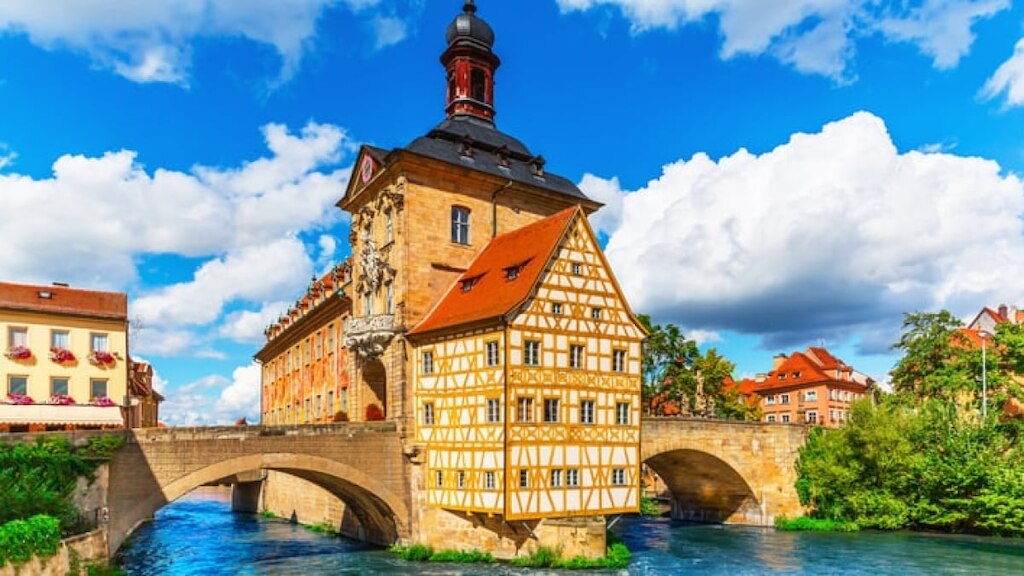
【World Heritage Site】What is the Town of Bamberg?|Cheers with Rauchbier! ◎
Jan 23, 2026
575 views
Bamberg, often called the “Pearl of Bavaria,” is a small town located north of Nuremberg. It is a precious ancient city and a World Heritage Site that developed on an island in the Regnitz River, a tributary of the Main. While many cities in Germany were destroyed during World War II, Bamberg miraculously escaped almost entirely unscathed. Because of this, its narrow winding alleys and old churches still allow visitors to experience Germany as it was in the Middle Ages, more than 1,000 years ago.
Like Rome, Bamberg spans seven hills and is also famous as the town of Rauchbier! Rauchbier, meaning “smoked beer,” is brewed with smoked malt just as its name suggests. In Bamberg, you can enjoy tradition not only in its architecture and townscape but also in its beer. Let’s take a closer look at the charm of this World Heritage Site.
table of contents
[x] close
【World Heritage Site】What is the Town of Bamberg?|Cheers with Rauchbier! ◎
What is the Town of Bamberg?
Bamberg first appeared in records in the 10th century. In 1007, Holy Roman Emperor Henry II established a bishopric and cathedral there. This led to Bamberg’s development as a church city, forming two districts that still exist today: Bergstadt, the religious quarter on the hills, and Inselstadt, the commoners’ town on the river island.
As mentioned earlier, because the city suffered little damage during the two World Wars, its streetscapes, formed 1,000 years ago, remain intact to this day. As a rare surviving example of medieval German urban structure, Bamberg was inscribed as a World Heritage Site in 1993.
Access to Bamberg
The most common way to reach Bamberg is by train from nearby major cities such as Nuremberg or Würzburg. From the former, a regional express takes 30 minutes; from the latter, it takes about an hour.
From Munich, which has an international airport, you can go directly by ICE express train. From Frankfurt, however, you need to transfer at Würzburg.
Recommended Spot ①: Bamberg Cathedral
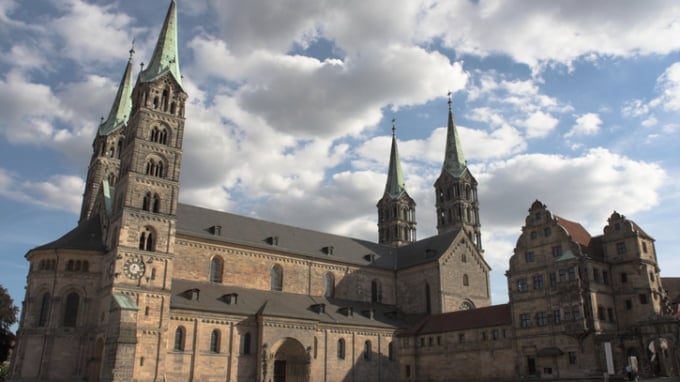
Located in the Bergstadt (meaning “hill town”) district of Bamberg, the cathedral rises with four spires 81 meters high and is one of the city’s grand World Heritage sites, built in the late Romanesque and Gothic styles. Commissioned by Holy Roman Emperor Henry II in 1004 and completed in 1012, it houses numerous precious works of art.
Among its highlights is the “Bamberg Rider,” a statue on the central staircase wall, often considered a masterpiece of medieval European sculpture. Yet, both the identity of the sculptor and the knight’s model remain unknown. The cathedral also holds Germany’s only papal tomb, as well as the tombs of Emperor Henry II and his wife. Their sarcophagi are regarded as masterpieces by the sculptor Tilman Riemenschneider.
Recommended The New and Old Residences
On the Domplatz (Cathedral Square) in front of Bamberg Cathedral stand two splendid palaces, considered among the most beautiful in Germany. The Renaissance-style Old Residence, built between 1571 and 1576, served as the bishop’s palace. Its atmosphere embodies the very image of medieval Germany and even served as a filming location for The Three Musketeers.
The Baroque-style New Residence, built in 1704 for the prince-bishop, exudes the grandeur of Paris and Vienna. Its rose garden is especially beautiful, filled with the elegance of the aristocratic era. From here, visitors can also enjoy sweeping views of Bamberg below.
Recommended Spot ③: The Old Town Hall and Little Venice
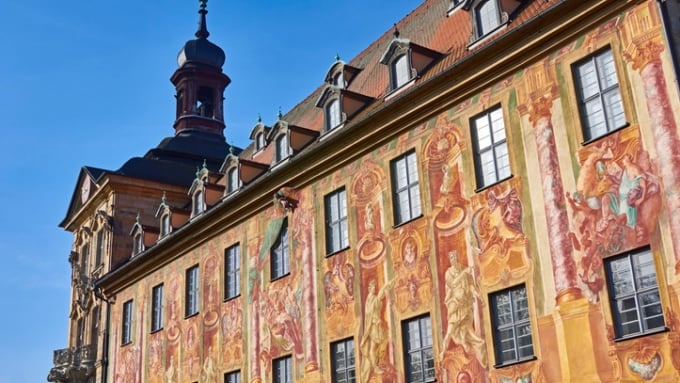
In Inselstadt, one of the must-see attractions is the Old Town Hall. It was built on an artificial island between two branches of the river, said to symbolize neutrality—belonging neither to the church nor the secular authorities. Constructed in the 14th century, its Rococo-style murals include allegorical paintings. One quirky detail: an angel’s painted leg protrudes in three dimensions from the wall.
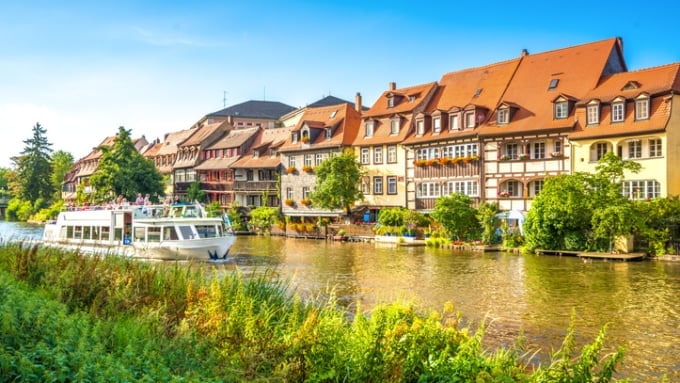
Nearby, a settlement of fishermen from the 19th century has become a famous sightseeing area known as “Little Venice.” Rows of colorful half-timbered houses add vibrant charm to Bamberg’s World Heritage cityscape.
◎ Summary
We’ve introduced the World Heritage city of Bamberg. Despite its small population of about 80,000, it is one of the best places in Germany to experience the atmosphere of the Middle Ages. In summer, you may see people practicing rowing on the Regnitz River or take a sightseeing boat cruise. Viewing Bamberg from the water offers a different and equally enchanting perspective.
Of course, when visiting Bamberg, be sure to savor its famous Rauchbier—whether on the hilltop among its churches and palaces, or by the riverside below.
RELATED ARTICLES



REGIONS
CATEGORIES
FEATURED ON Germany
-

Wilhelmshöhe Castle Park UNESCO World Heritage Site – A Stunning Landscape Shaped by Rolling Hills
-
Representative Souvenirs of Hannover, a City Home to a World-Famous Confectionery Manufacturer
-

【World Heritage Site】Wadden Sea|A vast wetland spreading across Germany, the Netherlands, and Denmark!
-
【World Heritage】What Is Hamburg’s Warehouse District?|Germany’s Largest Port Trading City!
-
Introducing All 5 World Heritage Sites in Slovenia! Explore the Magnificent World Heritage of This Small Country
MOST POPULAR ON Germany
-
 1
1Doha: Must-see Attractions in the Capital of Qatar
-
 2
2Toronto: 10 Things to do in this Picturesque Canadian City
-
 3
3Amarillo: A City Famous for It’s Amazing Canyons, Great History and Music
-
 4
4South Korea: Dazzling Scenery, Rich Culture and Fascinating History
-
 5
5Kuwait: A Country in Middle East Asia Famous for Hot Sand Dunes and Stunning Cityscape