


Name: Baalbek
Address: Baalbek, Lebanon
Official/related site URL: http://whc.unesco.org/en/list/294
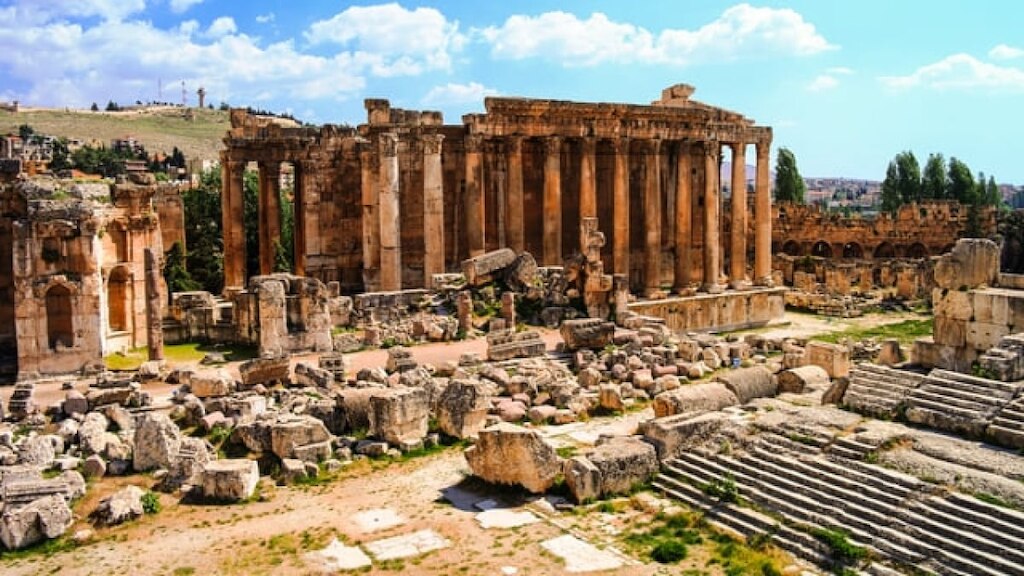
One of the Three Great Ruins of the Middle East! The Magnificent and Beautiful World Heritage Site of Baalbek, Lebanon
Apr 29, 2026
256 views
The World Heritage Site “Baalbek,” located in eastern Lebanon, is counted as one of the three great ruins of the Middle East. It is believed to have originally been a sacred site of the Phoenicians, who developed around the Lebanon area, but most of the structures visible today are from the Roman era. It is an awe-inspiring temple ruin lined with massive entasis-style columns typical of Rome or Greece.
Although there are many ruins from the Roman period around the world, the temples of Baalbek are particularly large and impressive. In this article, let’s take a look at the charm of Baalbek, which was inscribed as a World Heritage Site in 1984.
table of contents
[x] close
One of the Three Great Ruins of the Middle East! The Magnificent and Beautiful World Heritage Site of Baalbek, Lebanon
What is Baalbek?
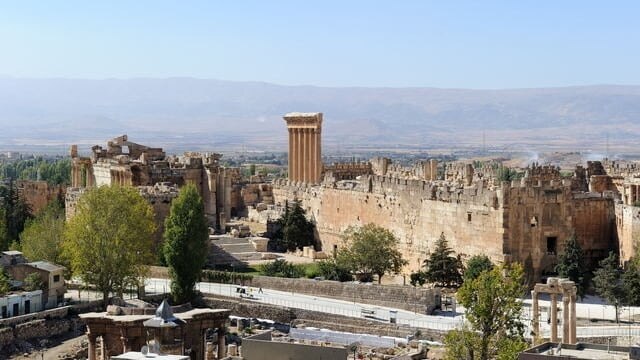
Baalbek means “Baal of the Beqaa Valley.” Baal was a god widely worshiped in the Canaan region, including by the Phoenicians, and was considered the chief deity in the Phoenician colony of Carthage.
Around the 1st century, it is thought that the Romans built the Temple of Venus here. Today Venus is mostly regarded as the goddess of beauty, but in Rome she was revered as the mother of Aeneas, the legendary ancestor of the Romans. In the 2nd–3rd centuries, the Temples of Jupiter and Bacchus were built, and these three temples are said to be larger than the Parthenon in Greece.
In the early 4th century, after Roman Emperor Constantine I was baptized into Christianity, Baalbek’s temples were converted into churches, and some were destroyed. In the 7th century, they were seized by the emerging Islamic forces and thereafter used as a fortress.
Access to Baalbek
From the “Cola Bus Terminal” in Beirut, the capital of Lebanon, shared buses depart for Baalbek. The journey to Baalbek takes about 3 hours.
There are no direct flights from Japan to Beirut’s Rafic Hariri International Airport. Travelers must connect via Istanbul, Dubai, Abu Dhabi, or other hubs.
Highlights of Baalbek (1): Temple of Jupiter
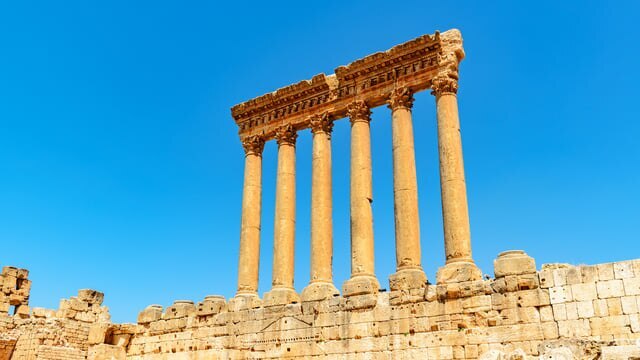
The six towering columns of the Temple of Jupiter are the symbol of Baalbek! Each rises an astonishing 22 meters high. The scale is considered even greater than that of Palmyra in Syria, another of the three great ruins of the Middle East.
Originally, 54 columns with a diameter of 2.5 meters stood on a platform measuring 85 meters in length and 47 meters in width, supporting the entire altar. Most of the temple collapsed in an earthquake around the 8th century, leaving only the six columns we see today. Still, looking up at them from below is overwhelming in scale.
Highlights of Baalbek (2): Temple of Bacchus
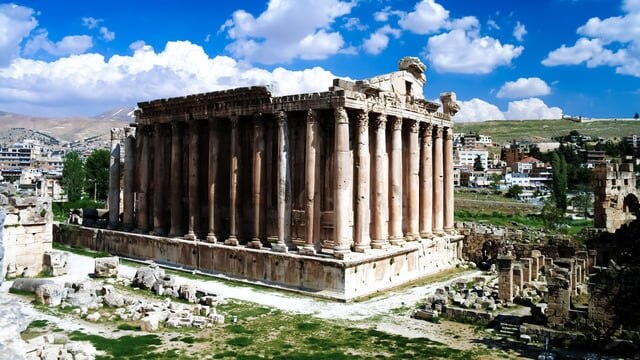
Among the structures of the World Heritage Site of Baalbek, the Temple of Bacchus is the best preserved. Visitors can even enter the temple and see the altar that was once used. The ceiling and column decorations in the Greek style are exquisite and worth seeing. Although Bacchus is the god of wine, the temple also enshrined the Syrian fertility deities Astarte and Atargatis.
The Temple of Bacchus measures 28 meters in height, 34 meters in width, and 69 meters in depth. This size far surpasses the Parthenon in Athens! A person standing at the entrance looks no bigger than a grain of rice compared to its massive scale. Be sure to visit Baalbek yourself to experience its grandeur firsthand.
Highlights of Baalbek (3): The Megaliths of Baalbek
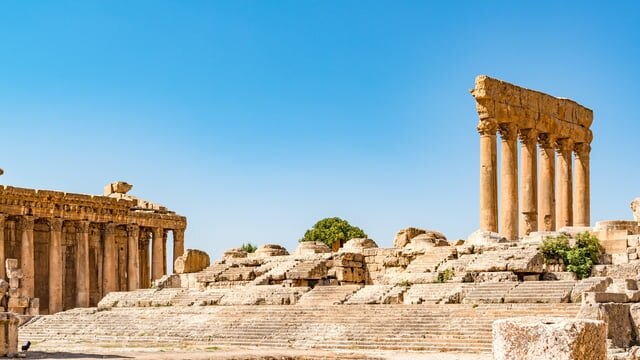
At Baalbek, there are giant megaliths known as the “Trilithon” (Three Wonder Stones). These are three huge blocks used in the foundation of the Temple of Jupiter, each about 18 meters long, 4 meters high and wide, and weighing 650–970 tons.
As building stones, they are among the largest ever used in the world, and how they were transported remains a great mystery. When you visit Baalbek, don’t miss the chance to see these megaliths, often classified as “OOPArts” (out-of-place artifacts), and confront the enigmas of ancient engineering.
◎ Summary
As of 2018, the area around Baalbek, which borders Syria, is under the Ministry of Foreign Affairs of Japan’s Overseas Safety Information Level 2 advisory. Compared to the past, the number of incidents such as foreigner abductions has greatly decreased, and security is gradually improving.
However, this does not mean the risks are gone. When visiting Lebanon, always check for the latest information and take thorough safety measures before traveling.
RELATED ARTICLES





REGIONS
CATEGORIES
FEATURED ON Lebanon
-
Scenic views where the Cedars of Lebanon Grow: The World Heritage Site of the Qadisha Valley and the Forest of the Cedars of God
-
[Safety in Lebanon] Be Careful! What You Need to Watch Out For Is Not Just Terrorism
-
The Intersection of Culture and Religion: 5 World Heritage Sites in the Mysterious Country of Lebanon!
-
Beirut, the Paris of the Middle East: 7 Must-Visit Attractions
-
Beirut : Paris of the East and the European Gateway to the Middle East
MOST POPULAR ON Lebanon
-
 1
1Doha: Must-see Attractions in the Capital of Qatar
-
 2
2Toronto: 10 Things to do in this Picturesque Canadian City
-
 3
3Amarillo: A City Famous for It’s Amazing Canyons, Great History and Music
-
 4
4South Korea: Dazzling Scenery, Rich Culture and Fascinating History
-
 5
5Kuwait: A Country in Middle East Asia Famous for Hot Sand Dunes and Stunning Cityscape