


Name: Aachen Cathedral
Address: Klosterplatz 2, 52062 Aachen, North Rhine-Westphalia, Germany
Official/Related Website URL: https://www.aachenerdom.de/en/
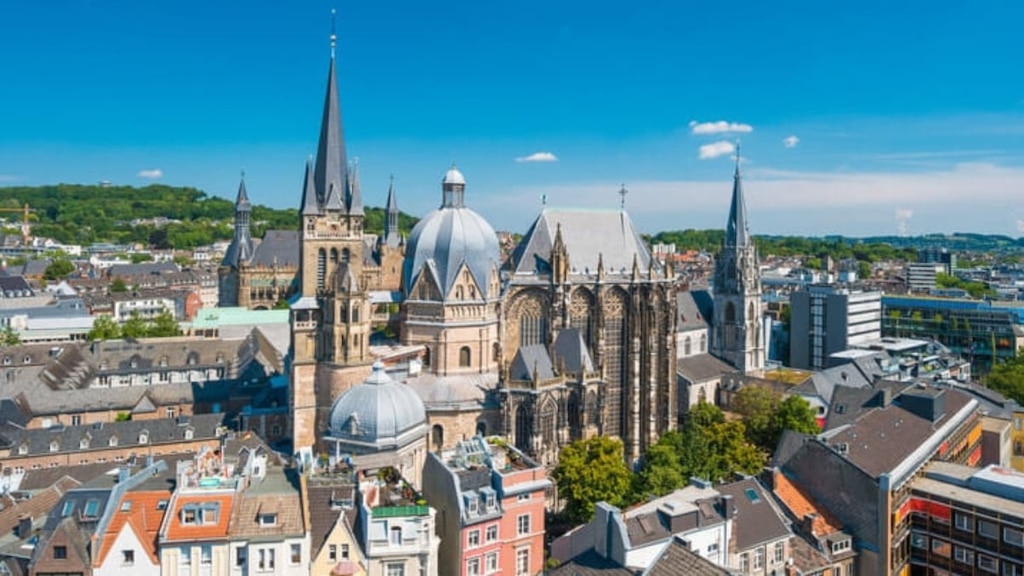
【World Heritage Site】What is Aachen Cathedral?|The appeal of the first registered World Heritage Site
Oct 6, 2025
756 views
The concept of World Heritage Sites began with the World Heritage Convention adopted at the UNESCO General Conference in 1972. It is a list to register and preserve ruins, landscapes, and natural sites that possess “outstanding universal value” shared by all humanity.
Based on this, the first World Heritage Sites were designated in 1978, with only 12 entries registered at that time (8 cultural heritage sites and 4 natural heritage sites). One of them was Germany's “Aachen Cathedral.” As of 2016, over 1,000 World Heritage Sites have been registered worldwide. Let’s explore the appeal of the memorable first World Heritage Site, Aachen Cathedral.
table of contents
[x] close
【World Heritage Site】What is Aachen Cathedral?|The appeal of the first registered World Heritage Site
What is Aachen Cathedral?
Aachen is a small city in western Germany, bordering Belgium and the Netherlands. The symbol of this city is Aachen Cathedral, the oldest cathedral in Northern Europe.
The name “Aachen” comes from Old German, meaning “spring,” and the area was already known as a hot spring resort during the Roman Empire. In the late 8th century, Charlemagne of the Frankish Kingdom built his imperial palace here, and the city developed as the de facto capital. The origin of Aachen Cathedral lies in the palace chapel built at that time. When Charlemagne died in 814, his body was buried here, and his remains are still preserved in the cathedral. From the late 10th century for about 600 years, Aachen Cathedral served as the coronation site for 30 Holy Roman Emperors. Due to its historical significance, it is also known as the “Imperial Cathedral.” It truly has a history worthy of being the first World Heritage Site.
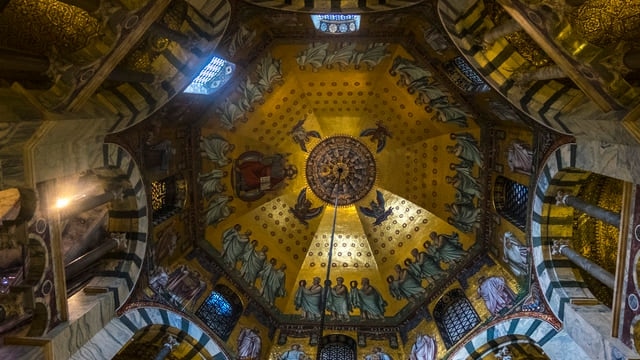
A distinctive feature of this World Heritage Site is the fusion of various architectural styles, including Classical, Byzantine, and Romanesque. At the center is a striking octagonal dome, 32 meters high, which symbolizes resurrection—8 being a sacred and symbolic number in medieval Christian belief.
Access to Aachen
From Frankfurt, it takes about 1 hour and 50 minutes; from Düsseldorf, about 1 hour and 30 minutes to reach Aachen Central Station. Since Aachen is also adjacent to Belgium and the Netherlands, you can also get there from Brussels by train in about 1 hour and 10 minutes. The train to Aachen takes just about 2.5 hours—convenient and close.
From Aachen Central Station to the cathedral, it takes about 10 minutes by bus or less than 20 minutes on foot, so walking while sightseeing around the city is a great idea. Along the way, you’ll find sights like the Elisenbrunnen (Elise Fountain), the Marschiertor (Marching Gate), and the Aachen Theatre.
Aachen Cathedral Highlight ①: The Glass Chapel
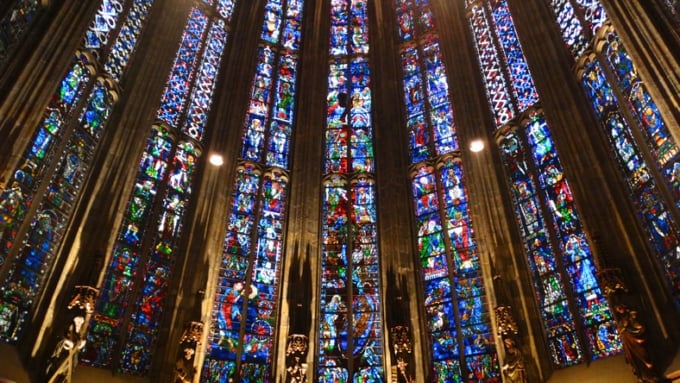
You’ll notice that Aachen Cathedral has a slightly unusual shape compared to other typical cathedrals. This is because it has been expanded multiple times over the centuries, with the original palace chapel at the center.
Among those expansions, the “Glass House” (Glass Chapel), constructed over approximately 60 years from 1355, is especially awe-inspiring within the historically significant Aachen Cathedral.
Its name comes from the stunning stained glass—25 meters high and covering more than 1,000 square meters—which will take your breath away. There is no entrance fee, but if you want to take photos, you must pay a separate photography fee, so please inform a nearby staff member.
Aachen Cathedral Highlight ②: The Cathedral’s Treasury Museum
The treasure chamber attached to Aachen Cathedral is considered one of the most important church treasuries in Northern Europe. It houses treasures from historic dynasties and items related to Charlemagne. One particularly famous item is the golden bust of Charlemagne, which even appears in German textbooks! Charlemagne established Aachen as the capital of the Frankish Kingdom and is said to have conquered and ruled almost all of Europe, excluding only the British Isles and Scandinavia. He is an especially significant figure in Franco-German history and is known as the “Father of Europe.”
Another must-see item is the Lothar Cross. It is richly adorned with numerous gemstones and features a temple-like shape supported by small columns when viewed from the side, said to represent the city of Jerusalem. The back is polished gold, and the cross was once carried at the front of Christian processions. The museum is filled with other astonishing gold and silver treasures—truly a treasure trove! Incidentally, this museum is also included in the World Heritage listing.
Aachen Cathedral Highlight ③: Carolus Thermen
Aachen has been famous as a hot spring area since ancient Roman times. So, after visiting the World Heritage Site, why not relax in the city’s renowned hot springs to ease your travel fatigue? The perfect spot for this is the large-scale hot spring facility “Carolus Thermen,” located northeast of Aachen’s Old Town. Note: it’s “Carolus,” not “Carlos.”
Though it’s a hot spring, as with most bathing facilities in Europe, wearing a swimsuit is strictly required. The water temperature is also on the lower side (35–40°C) since it’s mineral spring water. The facility is divided into three areas: heated pools, saunas, and spa treatments.
The pool area is particularly impressive. Centered around a large circular pool, the three-story-high open space and its supporting colonnades create a powerful architectural impact. Around it, there are bubble pools, jet pools, cave pools, and relaxation zones. You might be surprised to find such a paradise less than 1 km from a World Heritage Site.
◎ Summary
We’ve introduced Aachen Cathedral, the first World Heritage Site ever registered. As one of the oldest churches in Europe, its interior and atmosphere are completely different from those of typical European churches. True to its nickname “Imperial Cathedral,” its grandeur and beauty stand out from the rest.
Additionally, the mineral springs that gave the city its name still exist today. Though it’s a small city, Aachen is filled with attractions and offers excellent transportation access, making it a recommended stop not only when visiting Germany but also during a tour of Northern Europe.
RELATED ARTICLES


REGIONS
CATEGORIES
FEATURED ON Germany
-
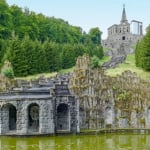
Wilhelmshöhe Castle Park UNESCO World Heritage Site – A Stunning Landscape Shaped by Rolling Hills
-
Representative Souvenirs of Hannover, a City Home to a World-Famous Confectionery Manufacturer
-

【World Heritage Site】Wadden Sea|A vast wetland spreading across Germany, the Netherlands, and Denmark!
-
【World Heritage Site】What is the Town of Bamberg?|Cheers with Rauchbier! ◎
-
【World Heritage】What Is Hamburg’s Warehouse District?|Germany’s Largest Port Trading City!
MOST POPULAR ON Germany
-
 1
1Doha: Must-see Attractions in the Capital of Qatar
-
 2
2Toronto: 10 Things to do in this Picturesque Canadian City
-
 3
3Amarillo: A City Famous for It’s Amazing Canyons, Great History and Music
-
 4
4South Korea: Dazzling Scenery, Rich Culture and Fascinating History
-
 5
5Kuwait: A Country in Middle East Asia Famous for Hot Sand Dunes and Stunning Cityscape